
Cross Stitching for Complete Beginners: Where to Start
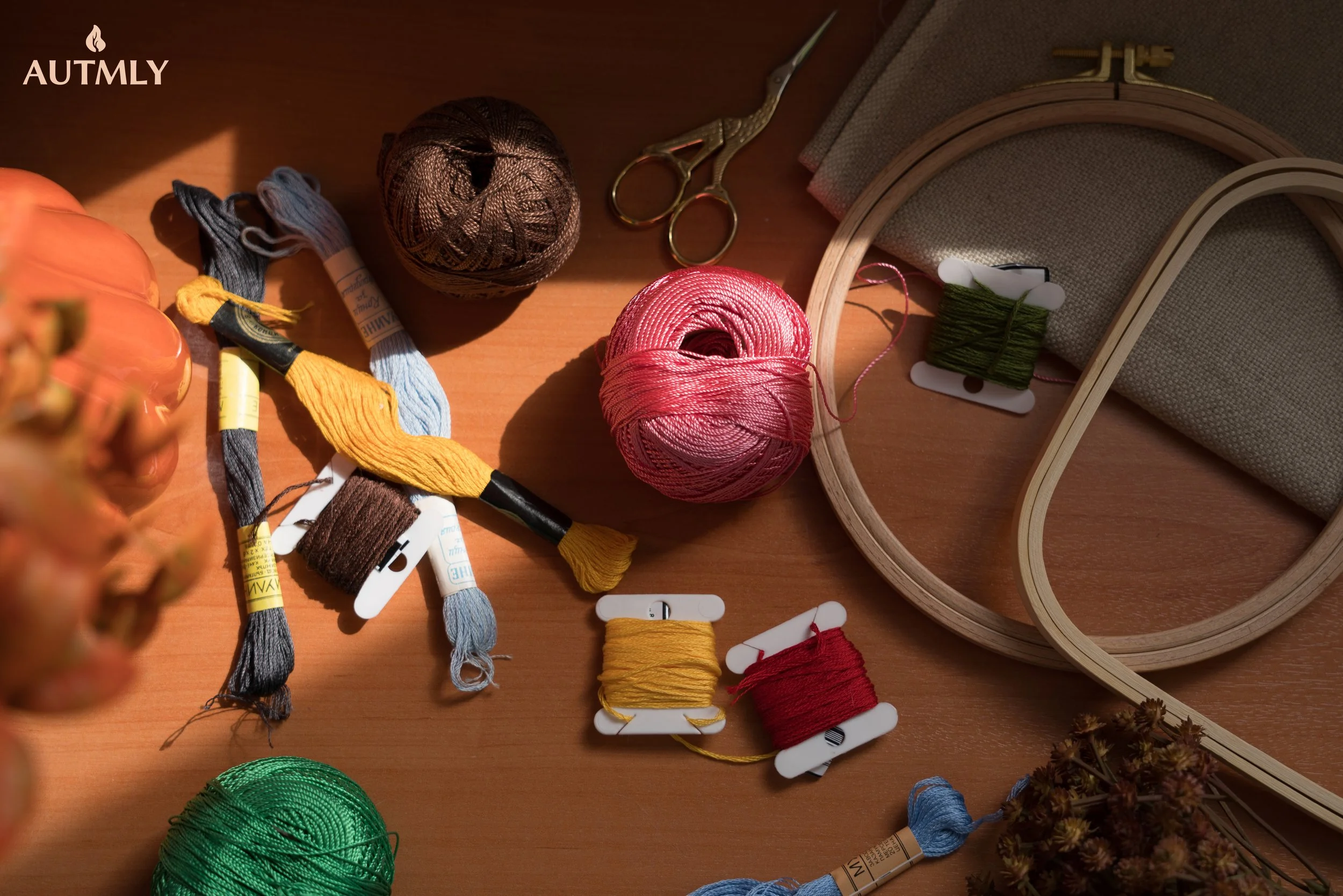
Original image taken and owned by Autmly
Starting a new hobby is rarely as straightforward as it looks. You can fall deep into the research rabbit hole, spending hours on forums, YouTube tutorials, pattern shops, thread charts, only to surface more confused than when you started. Or you go in the opposite side of the scale entirely, just like yours truly usually does. You watch a satisfying thirty-second clip of someone stitching a gorgeous little fox or a floral pattern, think “That looks easy enough!”, buy a kit on impulse, and then quietly shove it to the back of a drawer when it turns out to be harder than you though.
Both paths lead to the same place….a hobby you never quite started.
This article is my attempt to help you avoid both traps. I've pulled together everything that actually matters for a complete beginner: what cross stitch is, what it costs, how long things realistically take.
What is cross stitching, exactly?
Cross stitch is a form of hand embroidery where you create images by making small X-shaped stitches on an even-weave fabric. Most commonly, that fabric is a stiff, grid-like material called Aida cloth. The grid makes it easy to count and place your stitches precisely, which is part of what makes it so beginner-friendly. You're essentially filling in a pixel art image using tiny Xs.
The finished result can be anything from a simple strawberry to an intricate landscape that takes months. What you make is entirely up to you and that range is one of the things people, myself included, love most about it.
Why do people love it?
For most people, myself included, it's the meditative quality. Once you've learned the basic motion, your hands work on autopilot. You can listen to a podcast or an audiobook, have your favorite show on the TV, enjoy your morning cup of warm beverage of choice. If you want to replace infinite scrolling and digital noise, try making a physical object you can actually hold in your hands.
Cross stitch is also very portable, which is something I’ve taken advantage of countless times. You can stitch on a train, in a café, at a family gathering, in the park….everywhere! You don't need a studio or a dedicated workspace. Just a place to sit and decent light would do.
And then there's the community. Online stitching groups, pattern shops, and social threads are warm, generous places. People share progress photos, swap tips, and genuinely celebrate each other's work. It's a lovely corner of the internet.
Let's talk about time (but honestly)
This is where some beginners get discouraged and I’ll be honest. Cross stitch is not fast, and that’s the point. It is a slow activity by design, so you should know what you're signing up for.
A rough guide to what you might expect:
1-3 Hours - Small bookmark or a design sampler (great first project)
5-15 Hours - A 10x10cm (4×4 inch) beginner design in a hoop
30-80 Hours - A medium-complexity piece, like a floral wreath
100+ Hours - Large detailed pieces - like full-coverage landscapes or portraits
These are rough estimates, and they depend heavily on the thread count of your fabric, the complexity of the design, and how quickly you pick up the rhythm. A dedicated stitcher putting in an hour a day might finish a medium project in a few weeks. Someone stitching only on weekends might take a couple of months.
Tip: Choose your first project to be as simple as possible. A tiny design you finish in a weekend will do more for your motivation than a gorgeous complex piece that drags on for six months before you've learned the basics. Start small, see if you like it and then scale up.
What does it cost to get started?
Here's the good news: cross stitch has one of the lowest barriers to entry of any craft. You don't need expensive equipment to begin, so you don’t have to worry about investing too much from the beginning. Below is an honest breakdown of two starting paths: the budget route and the slightly more invested version.
Budget Starter ~€15–25 ($18-$30) total
Beginner kit (including fabric, hoop, basic threads, needle, pattern) - €8–€15
Extra DMC floss skeins (a few colours) - €1–€2 each
Free patterns online (Pinterest, Etsy freebies) - €0
Scissors (you probably already own some) - €0
Invested Starter ~€50–€80 ($60-$90) total
Quality Aida cloth (14-count, white or antique) - €5–€10
Wooden embroidery hoops (a couple of sizes) - €8–€15
Full starter set of DMC floss (30–50 colours) - €20–€35
Good tapestry needles (pack of 10) - €3–€5
A paid pattern you genuinely love - €3–€8
Disclaimer: Those prices will probably vary depending on where you live but it should give you just a rough idea
Honestly, starting your journey with a budget kit is completely valid. Many experienced stitchers started with a £10 kit from a craft shop and never looked back. The invested route just means fewer compromises. Better fabric feels nicer to work with, and having a range of thread colors means you're not constantly ordering singles.
One thing that tends to grow expenses over time is definitely thread. DMC floss for example costs around €0.60–€1.20 per skein, and complex patterns can call for 30, 50, or even 80+ colors. Most stitchers build their collection gradually and you most likely won’t have to buy everything at once.
What to skip at the start: You don't need a scroll frame, a special light pad, embroidery scissors (regular small scissors work fine), or a professional hoop stand, at least not yet. These are nice-to-haves that make sense once you know you love the craft.
Your first three things to do
If I was to start my cross-stitch journey again today, here’s what I would do:
Pick up a beginner kit or buy a small piece of 14-count Aida, a pack of DMC floss in two or three colors, and a needle. That's genuinely all you need.
Watch a short YouTube or TikTok tutorial on the basic cross stitch method. Seeing the hand motion makes everything click far faster than reading about it.
Choose a pattern you actually like. Stitching something you find beautiful (and simple!) keeps you coming back to it. There are thousands of free patterns online, from botanicals to funny modern sayings to classic geometric samplers.
Don't worry about doing it perfectly at first. Just like any hobby it would take a little practice. Your first row might look a bit wobbly. That's completely normal and it corrects itself quickly as you build muscle memory.
One stitch after another
I hope this article gave you enough to take that first step without feeling like you need a degree in needlework first. I kept the detail light on purpose. There's a lot more to explore, but none of it matters until you've got a needle in your hand. Coming up on the blog: a proper look at threads and fabrics, the mistakes almost every beginner makes, and a curated list of resources that are actually worth your time.
I hope you join me in the exploration of this wonderful hobby 🧵
You can find some more guides, organizational helpers and free beginner patterns on this page -Resources