
Let’s Talk About Thread: DMC vs Anchor vs Ariadna
©All Rights Reserved by Autmly, original image
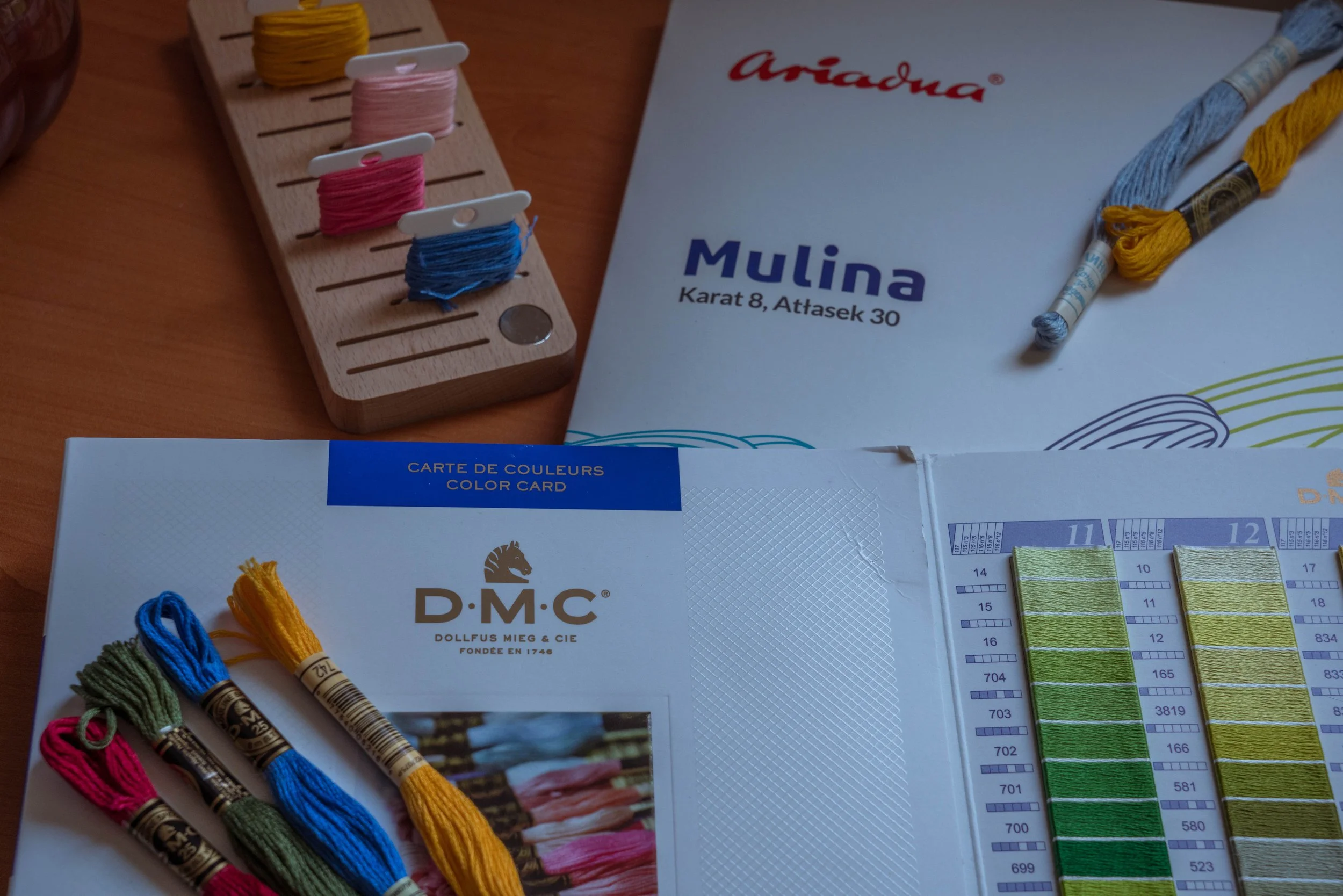
A few months ago my grandmother gifted me her old sewing materials. I was so genuinely happy because there was so much threads and evenweave….I woulnd’t have to worry about buying materials for a while 🥹 But I found a lot of different thread brans. Some skeins said DMC, a few said Ariadna, and a handful had a logo I'd genuinely never seen before - Anchor. There was even an old Bulgarian brand that was no longer in production so it was definitely one of a kind. I sat there wondering how different these brands actually were and whether I could use them together.
If you've ever stood in a craft shop staring at a wall of floss, wondering why some skeins cost twice as much as others, this one is for you.
The big names you'll keep running into
DMC is the brand most patterns are written for. It's a French company that's been making thread since 1746, and its stranded cotton range now sits around 500 colors. If a pattern simply lists a number like "310", it's almost certainly a DMC code. The thread itself has a slightly silky finish and separates into strands cleanly, which makes a real difference once you're working with one or two strands on finer fabric.
Anchor is the other big player, especially across the UK and continental Europe. It's made by Coats and has a history almost as long as DMC's. Its color range sits a little smaller, somewhere around 440 to 460 shades, and it uses its own numbering system entirely, so you'll need a conversion chart if your pattern is written in DMC. The texture is slightly softer and less shiny than DMC, which some stitchers actually prefer.
Then there's Ariadna, a Polish manufacturer that's been around since before the 19th century and is now the largest thread producer of its kind in Poland. You'll see it a lot across Eastern Europe, often sitting on the same shelf as DMC in local craft shops. Its colour range is smaller than DMC's, but it covers the essentials well, and it tends to be noticeably cheaper where it's sold.
What the color range actually means for you
A bigger color range mostly matters when you're after very fine gradations, the kind of subtle shift between two almost-identical blues that a portrait or a shaded sky needs. DMC's 500 shades give you that level of detail. Anchor's slightly smaller range covers nearly everything a typical pattern asks for, and Ariadna's range, while the most limited of the three, is more than enough for beginner and intermediate projects.
The bigger practical issue isn't the size of the range. It's the numbering. DMC, Anchor, and Ariadna each use their own system, so a "DMC 310" and an "Anchor 403" aren't directly linked unless you check a conversion chart.
Quality and how the thread feels in your hand
All three brands use mercerized cotton, which means the fibres have been treated to add shine and help the dye hold. In practice, this means all three are colorfast and hold up well to washing, even after years on the wall.
DMC has the most noticeable sheen and a very smooth feel. Anchor is a touch softer and more matte, which some people find easier to work with for long sessions. Ariadna sits somewhere in between, and reviewers generally describe it as good quality, though a few shades can vary slightly more between dye lots than you'd expect from DMC.
For most hobby projects, honestly, you won't notice a quality gap between any of these in the finished piece.
Price and where you'll actually find them
DMC is everywhere, which is part of why it's the default. Skeins typically run somewhere around fifty cents to a dollar each, depending on where you shop and whether there's a sale on.
Anchor tends to be similarly priced or slightly cheaper in the UK, but it can be harder to find (and pricier) outside the UK and parts of Europe, since big-box stores in other regions often don't stock it.
Ariadna is usually the most budget-friendly option if you're shopping in Poland, Bulgaria, or nearby countries, but it's much harder to track down if you're stitching from, say, the US or Canada.
Thread brand comparison
|
DMC France · est. 1746 Most patterns use this |
Anchor UK (Coats) UK & Europe favourite |
Ariadna Poland Budget-friendly pick |
|
|---|---|---|---|
| Color range | ~500 shades | ~450 shades | ~385 shades |
| Price per skein | $0.50–$1 | Similar; slightly less in UK | Usually the cheapest locally |
| Texture | Smooth, slight sheen | Softer, matte finish | Good mercerized cotton; slight lot variance |
| Availability | Worldwide | Strong in UK & Europe; patchy elsewhere | Eastern Europe; hard to find elsewhere |
| Numbering | Own system, used as default in most patterns | Own system; needs conversion chart for DMC patterns | Own system; often lists DMC equivalents on packaging |
| Best for | Following any pattern exactly as written | UK and European stitchers, budget swaps | Local, everyday stitching on a budget |
So, can you mix brands in one project?
Yes, and it's far more common than you'd think. Plenty of stitchers keep a mixed stash and reach for whatever brand has the colour they need.
The one thing to watch for is sheen. DMC's slightly glossier finish can stand out next to Anchor's matte one if the two sit right next to each other in a large block of a single colour. My rule of thumb: if I'm filling a big solid area, I try to stick with one brand for that whole section. For scattered detail work, mixing barely shows at all.
If you're substituting a colour because your usual brand doesn't have it, hold the new skein up against your fabric in daylight before you commit. A conversion chart gets you close, but your own eyes are the final word.
These days my stash is a slightly chaotic mix of DMC, Anchor, and Ariadna, and honestly, it works just fine. Sometimes the "wrong" thread turns out to be exactly the color I needed.
I have a free DMC thread tracker on the Resources page you can check out.
Happy stitching!
Follow me on Instagram @autmly_official