
Micro-Journaling: A Daily Practice That Shifts Your Inner Voice

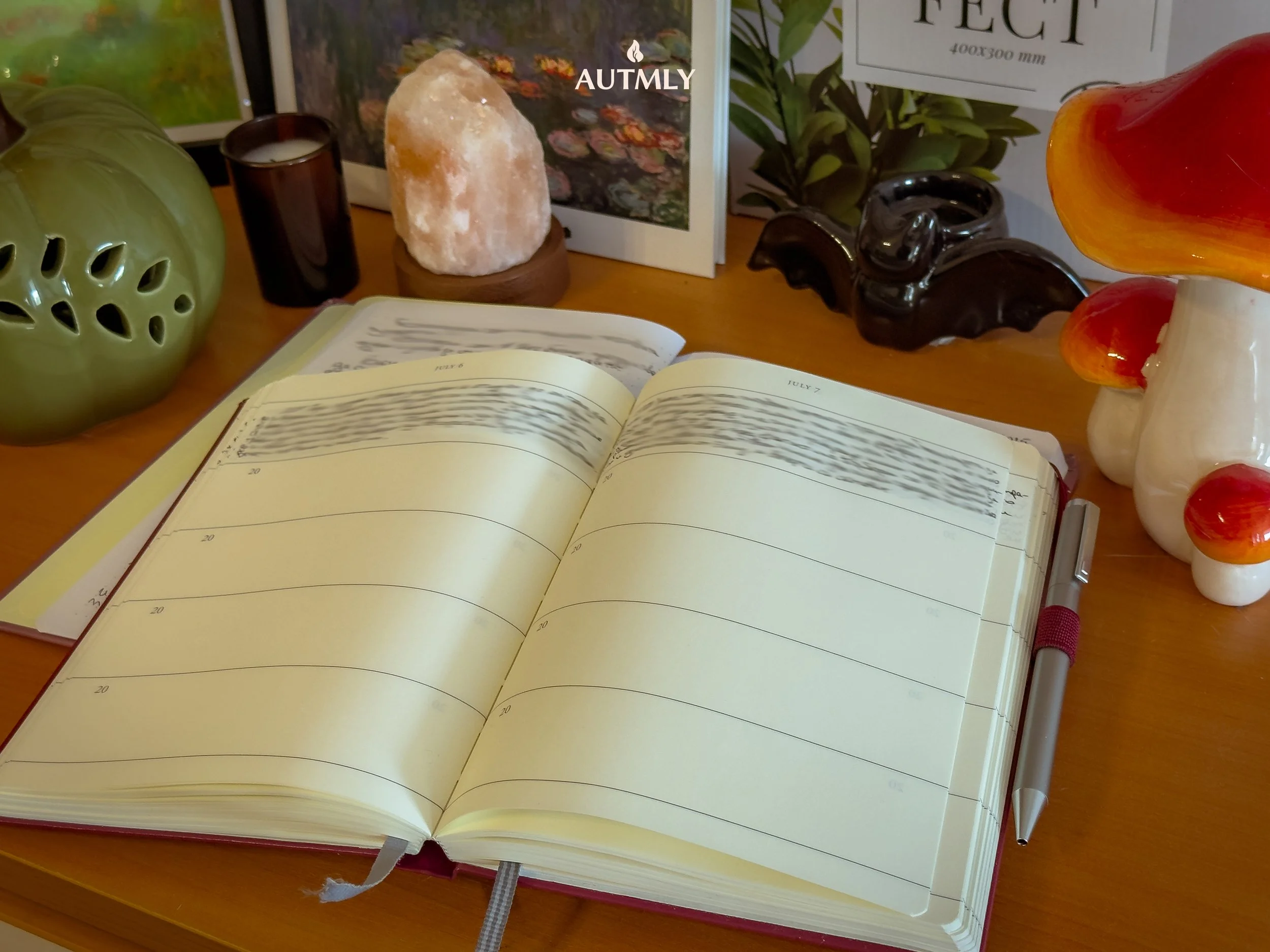
Original image, taken and owned by Autmly
I have to say that journaling and I have a long and complicated relationship. Over the years I’ve tried documenting my days many times and in many different forms - handwritten notebooks, digital journals, video logs, apps. Nothing seemed to stick, and eventually I just gave up and accepted that I wasn’t the kind of person who could keep a journal.
However, this past year, something shifted. I started incorporating a different kind of journaling into my life, almost by accident. It began with a Leuchtturm1917 “Some Lines A Day” five-year journal that I picked up. Each page is dedicated to a date, divided into five small sections - one for every year. The simplicity of the format appealed to me and the color was beautiful, so of course I bought it.
What ended up working for me this time was surprisingly the limited space. I didn’t feel overwhelmed by the expectation to write pages of reflections. Instead, all I needed to do was sit down for a minute and think about what captured my attention that day - a highlight, a moment, a feeling, a thought. That tiny ritual, just a few lines at a time, finally made journaling accessible.
And that’s when I realized that maybe micro-journaling (the practice of writing for just a few minutes a day) might be the most sustainable way to shift your inner narrative. And apparently neuroscientists and psychologists are increasingly recognizing such practices as profoundly transformative.
Why Micro-Journaling Matters
Can just 5 minutes make a big difference? According to research - definitely "Yes!"
Dr. James Pennebaker, a psychologist at the University of Texas at Austin, has spent over three decades studying the effects of expressive writing. His landmark research found that writing about thoughts and feelings for just 15-20 minutes over a few days can lead to measurable improvements in both mental and physical health. Participants in his studies showed reduced symptoms of depression and anxiety by 20-45%, improved immune function, and even faster wound healing.
But here's what makes micro-journaling particularly powerful: consistency matters more than duration. Research from the University of Calgary's 2022 systematic review found that journaling three to four times per week provides optimal results, and even 10 minutes of writing offers measurable benefits. The key isn't writing a novel about your day - it's the regular act of translating your internal experience into words.
When you put pen to paper, you're engaging both the language production and comprehension areas of your brain. This creates what researchers call "coherent narrative construction" - essentially, you're helping your brain make sense of scattered thoughts and feelings by organizing them into a structured story. This process frees up mental resources previously occupied by intrusive thoughts, which is why studies show that regular journaling improves working memory and cognitive performance.
The Inner Voice
We all have an inner narrator, a little voice that colors how we see ourselves, our days, and our place in the world. For many of us, this voice has been shaped by years of accumulated experiences, beliefs, and yes, criticisms. Research on inner speech reveals that this internal dialogue directly influences our emotional regulation, self-concept, and even our stress response. According to studies published in Trends in Cognitive Sciences, the way we talk to ourselves creates neural pathways that either enable or limit our capabilities.
Perhaps the most fascinating aspect of micro-journaling is its impact on neuroplasticity (your brain's ability to form new neural pathways). Research from the National Institute of Mental Health demonstrates that cognitive restructuring techniques, including structured journaling, create measurable changes in brain activation patterns within just 4-6 weeks of consistent practice.
When you write down negative thoughts, something interesting happens. They lose their power. Once externalized on the page, these thoughts can be examined objectively rather than accepted as absolute truth. This process aligns with cognitive behavioral therapy principles, where identifying and challenging distorted thinking patterns leads to shifts in self-concept and emotional well-being.
A 2018 study from the University of Toronto found that journaling helps people accept rather than judge their mental experiences, resulting in fewer negative emotions in response to stressors. By regularly engaging with your thoughts through micro-journaling, you're essentially training your brain to respond differently to the same situations that once triggered automatic negative reactions.
A Quiet Shift
You won't necessarily feel different after your first entry, or even your tenth. But somewhere around week three or four, you might notice that the critical inner voice has softened slightly or that the anxious thoughts feel more manageable.
This is neuroplasticity in action. With each brief journaling session, you're strengthening new neural pathways and allowing old, unhelpful patterns to weaken through disuse. As neuroscientists say: neurons that fire together, wire together. By consistently engaging in this practice, you're literally rewiring your brain's default narratives.
A meta-analysis published in Family Medicine and Community Health found that while journaling had a positive effect on both men and women being treated for anxiety, the practice showed measurable improvements in patient health measures with a 5% difference between journaling groups and control groups. The researchers concluded that given the low risk of adverse effects and low resource requirements, journaling should be considered as an adjunct therapy in primary care.

How to Start Micro-Journaling
The beauty of micro-journaling is that there's no "right" way to do it. However, research suggests that structured prompts often produce stronger effects than blank pages. Here are three evidence-based approaches you can try:
Morning Intention Setting (2-3 minutes)
Start your day by writing down three things:
1. One thing you're grateful for (specific, not generic)
2. One intention for the day (what you want to focus on or how you want to show up)
3. One affirmation (a statement about who you're becoming, not who you wish you were)
Writing down your goals makes you 42% more likely to achieve them, according to studies by Dr. Gail Matthews at Dominican University.
Evening Reflection (3-5 minutes)
Before bed, reflect on:
1. What went well today? (even small moments count)
2. What did I learn about myself?
3. How could tomorrow be even better? (framed as curiosity, not criticism)
Studies on journaling found that participants who focused on positive aspects of their day for 15 minutes, three times per week, showed significant reductions in anxiety and improvements in overall well-being after just one month.
Stream-of-Consciousness Release (5 minutes)
When emotions feel overwhelming, set a timer and write continuously without editing or judgment. Let whatever needs to come out find its way onto the page. Research on expressive writing shows that even temporary emotional intensity during the writing process leads to significant long-term benefits in mental health and stress reduction.
Daily Highlight (1-2 minutes)
This is similar to my approach with the "Some Lines A Day" journal: simply identify what captured your attention that day. What stood out? What moment would you want to remember? This practice trains your brain to notice the meaningful moments rather than getting lost in the mundane or stressful parts of your day.
Consistency
The biggest hurdle with micro-journaling isn't the practice itself - it's keeping it a part of your daily routine. Here are a few research-backed strategies to help:
Find a format that removes intimidation.
Whether it's a five-year journal with limited space, a structured app, or simple bullet points—the format matters less than finding something that doesn't feel overwhelming. My "Some Lines A Day" journal works precisely because the small sections eliminate the pressure to write extensively.
Anchor it to an existing habit.
Write while your morning coffee brews or right after brushing your teeth before bed. Studies on habit formation show that linking new behaviors to established routines significantly increases success rates.
Keep your journal visible.
Out of sight truly is out of mind. Place your journal somewhere you'll see it daily.
Start impossibly small.
Even one sentence counts. Research shows that lowering the barrier to entry increases the likelihood of maintaining the habit long-term.
Don't aim for perfect.
Some days you'll write three pages, other days three words. Both count. The goal is consistency, not perfection.

Journaling Prompts to Get You Started
If you're staring at a blank page wondering what to write, maybe these prompts can help. Choose one that resonates with you each day, or rotate through them to explore different aspects of your inner world:
1. What assumption did I make today that might not be true?
2. What small moment today made me smile?
3. Who or what am I taking for granted that I could appreciate more deeply?
4. What would I do today if I knew I couldn't fail?
5. What emotion have I been avoiding, and what might it be trying to tell me?
6. If I could give my past self (from a year ago) one piece of advice, what would it be?
7. What's one small action I could take tomorrow that my future self would thank me for?
8. How do I want to feel by the end of this week?
9. What story did I tell myself today that I’m not sure is fully true?
10. What’s one thought or behavior pattern I’m trying to rewire - and what tiny step supports that?
You can answer those question as shortly as you like, you don't have to write paragraphs or pages. Start small and maybe in time the inner voice that has perhaps been critical, anxious, or doubting can gradually become more compassionate, curious, and confident.
Thank you for reading and I hope I see you next time. 🍂
Keep your heart cozy - no matter the season.
——————————————————————————
Sources for this article:
1. Pennebaker, J. W., & Chung, C. K. (2007). Expressive writing and its links to mental and physical health. Oxford Handbook of Health Psychology.
https://greatergood.berkeley.edu/article/item/how_journaling_can_help_you_in_hard_times
2. Sohal, M., Singh, P., Dhillon, B. S., & Gill, H. S. (2022). Efficacy of journaling in the management of mental illness: a systematic review and meta-analysis. Family Medicine and Community Health.
https://pmc.ncbi.nlm.nih.gov/articles/PMC8935176/
3. Baikie, K. A., & Wilhelm, K. (2005). Emotional and physical health benefits of expressive writing. Advances in Psychiatric Treatment, 11(5), 338-346.
https://www.reflection.app/blog/benefits-of-journaling
4. Klein, K., & Boals, A. (2001). Expressive writing can increase working memory capacity. Journal of Experimental Psychology: General.
https://www.reflection.app/blog/benefits-of-journaling
5. Matthews, G. (2015). Goal Research Summary. Dominican University of California.
https://www.omaritani.com/blog/daily-journal
6. Ford, B. Q., Lam, P., John, O. P., & Mauss, I. B. (2018). The psychological health benefits of accepting negative emotions and thoughts. Journal of Personality and Social Psychology.
https://positivepsychology.com/benefits-of-journaling/
7. Latinjak, A. T., Morin, A., Brinthaupt, T. M., et al. (2023). Self-Talk: An Interdisciplinary Review and Transdisciplinary Model. SAGE Journals.
https://journals.sagepub.com/doi/10.1177/10892680231170263
8. National Institute of Mental Health Research (multiple studies). Cognitive restructuring and brain activation patterns.
9. Alderson-Day, B., et al. (2018). Inner speech studies in Trends in Cognitive Sciences.
https://www.cell.com/trends/cognitive-sciences/fulltext/S1364-6613(23)00210-3
10. Emmons, R. A., & McCullough, M. E. Research on gratitude journaling.
https://www.intelligentchange.com/blogs/read/benefits-of-journaling